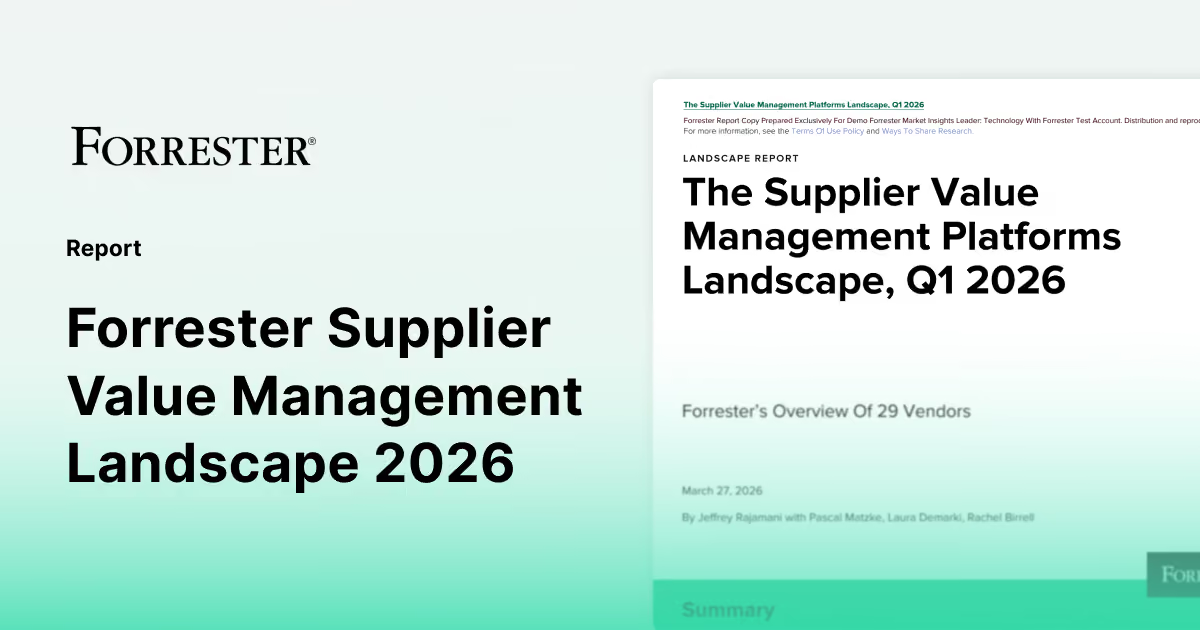
Forrester Supplier Value Management Landscape 2026 Report
Discover how leading enterprises use procurement orchestration and intake layers to bridge fragmented legacy systems, eliminate ERP fatigue, and power autonomous, agentic AI workflows.
The supplier value management (SVM) market is rapidly evolving into a $20 billion category, driven by CPO demands for automated transactional processes, consumer-grade user experiences, and agentic AI. As source-to-pay (S2P) suites and specialist tools converge into hybrid composable architectures, technology leaders require independent analyst research to select software that unifies cross-system complexity without forcing costly system replacements.
Read this complimentary copy of The Supplier Value Management Platforms Landscape, Q1 2026 by Forrester Research analyst Jeffrey Rajamani to explore key market dynamics, evaluate 29 notable vendors across size and geography, and discover why procurement orchestration and intake management have emerged as critical extended use cases for modern enterprise spend.
Download the report to gain complete access to Forrester’s market breakdown, vendor matrix, and strategic advice for technology leaders evaluating Supplier Value Management platforms.
Navigating the Shift to Composable, Agentic Procurement
Forrester’s Q1 2026 assessment highlights a structural transition in procurement technology: the shift from deterministic, rule-based automation to predictive, agentic AI. As organizations face fragmented master data, ERP fatigue, and global supply volatility, market maturity favors platforms that act as a connective fabric—delivering a unified front door for business users while silently orchestrating complex workflows across downstream finance, risk, and legal tools.
Key Takeaways: Four Questions Procurement and IT Leaders Must Ask
The Forrester report provides CPOs, digital transformation executives, and technology leaders with a pragmatic framework to evaluate vendor capabilities. As you refine your digital roadmap for 2026 and beyond, assess how your current technology stack addresses these core industry findings:
1. Is your intake layer preventing maverick spend—or driving users away?
- Analyst Finding: Buyers prioritize user experience over sheer functionality. Poorly navigated tools drive employees to bypass official channels, whereas intuitive intake platforms serve as a simple "front door" that guides purchasing decisions, improves data quality, and reduces unapproved spending.
- The Question for Your Stack: Does your request process force business stakeholders to navigate complex, multi-portal systems, or does it deliver a zero-training, walk-up experience that captures intent in plain language?
2. Are you waiting for spotless master data before deploying AI?
- Analyst Finding: Disconnected systems and poor data quality undermine trust in legacy platforms. However, tech leaders do not need to wait for perfect data: modern AI-powered SVM platforms continuously self-learn, enrich master data, and extract transaction details across disparate silos.
- The Question for Your Stack: Is bad supplier data paralyzing your automation initiatives, or is your software capable of self-healing and normalizing vendor master data across your global ERPs in real time?
3. Does your architecture support a hybrid, composable ecosystem?
- Analyst Finding: Enterprise procurement is settling on a hybrid model where traditional suites serve as operational backbones while specialized orchestration layers extend innovation at the edges via open APIs and unified data models.
- The Question for Your Stack: Are you trapped in a rigid, monolithic suite, or can your architecture orchestrate dynamic parallel approvals across IT, legal, finance, and TPRM without complex custom code?
4. How is your organization transitioning from deterministic to agentic AI?
- Analyst Finding: The top disruptor in the market is AI-powered SVM platforms operating with minimal human intervention. Autonomous AI agents now triage intake, validate purchase orders, check budget thresholds, and trigger risk assessments at scale.
- The Question for Your Stack: Is your AI limited to basic form autofill and chatbots, or are autonomous agents actively executing end-to-end tasks with complete auditability and enterprise guardrails?
ORO Labs: Purpose-Built for Enterprise Procurement Orchestration
ORO Labs is named by Forrester as a notable vendor for the report, focused on North America and EMEA enterprise environments with Intake Management, Procurement Orchestration, and Business Network as its top extended areas of focus—the core capabilities modern enterprises require to orchestrate complex global spend.
Analyst Insight
"Specialist vendors... expand into extended use cases with rapid, cheap, and easy implementations... Modern procurement platforms will be the source of truth for everything to do with procurement but with automatically updated, self-healing data. Users will want continuous sensing and real-time response capabilities that synthesize internal data, market data, and supplier insights." — Jeffrey Rajamani, Principal Analyst, Forrester Research
.avif)
.png)


.avif)

.svg)